
Water Line Replacement
At Cleburne Pipe Pros, we provide water line replacement services for homes throughout Cleburne. If an aging or damaged line is causing leaks, low water pressure, discoloration, or repeated repairs, we can assess the system and replace the failing section with a dependable new water line.
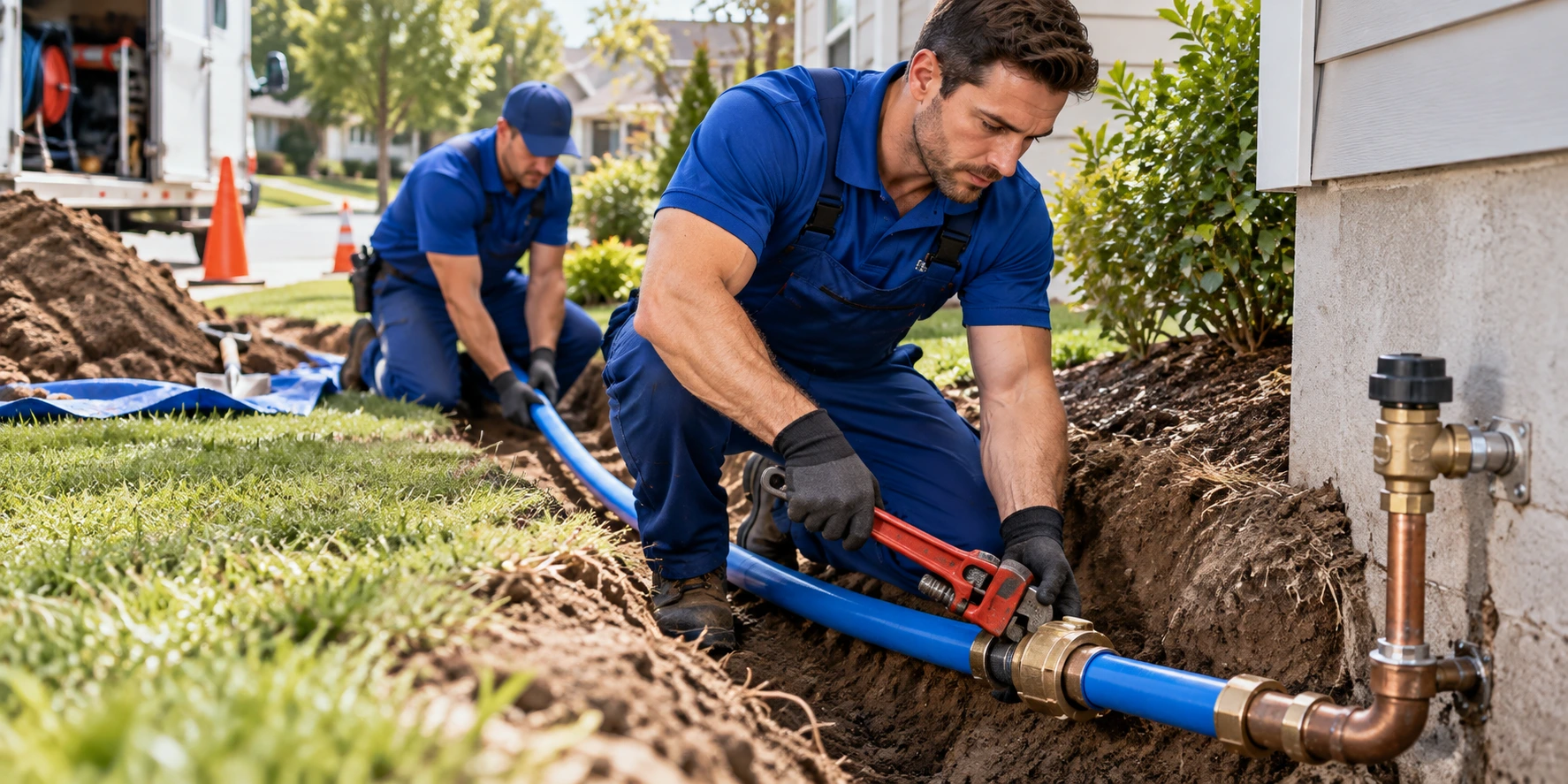
Water line replacement in Cleburne for the buried run
Cleburne Pipe Pros replaces the buried water line from the meter to the house for homes and businesses in Cleburne, Keene, Rio Vista, Grandview, and Alvarado. We work on houses, townhomes, condos, and businesses when pressure drops, the yard stays wet, or a short repair will not hold. Water line replacement in Cleburne, TX is how we stop a failing meter run from starving every fixture in the home.
Along with that yard line we still take drain cleaning, hot water heater repair, fixture installation, garbage disposal repair, emergency plumbing, and leak detection when those systems are what the house needs. In 76033, Prairie Avenue homes from the 1890s through the 1920s often still feed the house through galvanized steel that constricts from the inside. That pinched pipe is why a tub fills slowly even when the neighbor on a newer street has strong flow.
We put a gauge on the meter setter, which is the short brass assembly the city meter sits in, and we isolate the house before we cut a trench. We leave the new shutoff labeled and the soil compacted when we pack up. We take water line calls 24/7, including nights when a break is soaking a slab-on-grade ranch.
Those first readings decide whether a coupling will hold or the whole service has to come out. The next section is the test order we use once we are on site. After the numbers are clear, we talk through materials and how much of the yard has to open.
Other Services
Contact Us Today!
(817) 506-6604
Open 24 Hours
Reliable plumbing solutions for homes throughout Cleburne, TX.
Professional repairs and installations completed with care, attention, and lasting results.
Need urgent plumbing help? Call Cleburne Pipe Pros for fast assistance with leaks, burst pipes, backups, and other plumbing emergencies. Call now
What we test first on a failing water line
Static pressure at the meter setter
Static pressure is the first number because it is the water City of Cleburne is sending before any house pipe can hide a problem. A gauge goes on the meter setter with the house still closed so the reading is clean. A strong setter and a weak kitchen means the drop is on our side of the meter. A weak setter means replacing the yard service will not fix the shower, and the trench stays closed for the wrong reason.
What a falling needle rules out
Next the gauge stays in place while the house shutoff closes. If the needle holds, the buried run is not losing water, which rules out a yard leak and sends attention to fixtures, a tired pressure regulator, or a line past the valve. If the needle falls, water is leaving between the meter and that shutoff. A meter dial that spins with every fixture off tells the same story, and that is when a full service replacement is on the table instead of a faucet washers job.
How we read the pipe we are about to replace
Then the pipe itself gets a look at both ends. Galvanized threads, copper, gray polybutylene (the plastic used on many services from 1978 to 1995), or PEX each fail in a different way, so the material tells us whether a coupling is worth installing. A 2000s PEX line nicked by a fence post is a different job than a 1970s galvanized run rusted end to end. Guessing from the decade of the house alone misses the patches previous owners left in the trench.
Where the wet soil sits in the yard
Last comes the wet soil. A dark fan from the meter toward the foundation usually means the yard service is open. Wet carpet, a warm floor, or a hiss under a slab-on-grade ranch points inside the concrete, and leak tracing takes over instead of a straight trench. We use same-day diagnosis on these four checks before any trench opens. The shovel waits until the readings agree on where the water is going.
Buried line failures that force a replacement
Galvanized steel that has closed down from the inside
A galvanized service rarely wakes anyone with one loud burst. It fades until the washer needs extra time and the shower dies when a toilet fills. That is daily life in Cleburne houses that still have original steel between the meter and the slab. Rust grows inward, the opening shrinks, and kitchen pressure no longer matches what we measure at the setter.
Signs it is time to call
- The tub fills slowly even with the valve wide open.
- The shower fades when someone flushes.
- Water at the meter feels stronger than water at the hose bib.
- Brown water shows up after the line sits unused overnight.
- A thread at the meter crumbles when a wrench goes on it.
- The pipe outside looks scaly and the fittings are lumpy with rust.
- A prior clamp is leaking next to the old one.
We do not ream a galvanized yard line and expect it to flow. The wall is already thin, and the next joint is the same vintage. The meter shuts, the buried path opens, and the service becomes a continuous new run to a labeled house valve. After the new pipe holds pressure, the old steel comes out of the trench. Downtown Cleburne around the Johnson County Courthouse still has this mixed pre-1950 galvanized stock.
Copper pinholes on the buried service
A copper service can look bright at the fitting and still weep through a pinhole under the grass. House pressure stays almost normal until several holes open, then the yard stays soft and the meter keeps moving. One hole is a repair question. Several holes in a short trench mean the pipe wall is tired and a new service is cleaner than a row of couplings.
What you might notice first
- A circle of greener grass that does not match the rest of the lawn.
- A meter that ticks with every tap in the house off.
- Low flow at two fixtures that do not share a shutoff.
- Green stain on copper where it comes out of the ground.
- A hiss near the foundation after rain has dried.
- Mud that returns in the same footprint after it is raked smooth.
- A water bill that jumped without a change in how the house is used.
On copper we open enough trench to see whether the rest of the pipe is sound. A single ding can take a coupling after a pressure test. Pinholes in a line, or green weeping at more than one joint, are why the whole meter-to-house stretch comes out. Houses off State Highway 174 still show this copper with one pinhole beside a sound stretch, and that is the only case where a section stays in the ground.
Polybutylene services from 1978 to 1995
Gray polybutylene is a different kind of failure than rust. The pipe and the acetal fittings get brittle together, so the first blister is rarely the last. Housing from that window sits on mid-century streets and in 1980s ranches, and the service often still runs from the setter to the slab in one gray piece. A clamp on that plastic buys a night, not a season.
How this shows up in the house
- The gray pipe at the meter has a cloudy, chalky look.
- A fitting has split in a clean ring instead of a rust hole.
- Wet soil follows the pipe even though the copper in the house looks fine.
- Pressure drops after a hot afternoon when the plastic has been in the sun near the wall.
- A previous owner left a metal clamp on a plastic blister.
- The house valve is plastic and weeps at the threads.
- The meter spins in short bursts with no fixture running.
When that gray plastic is on the service, the whole buried line is treated as due for replacement. New pipe goes from the setter to a new house valve, and none of the polybutylene stays as a stub that can fail next to the joint. City of Cleburne pressure at the setter is usually fine while this plastic is the weak link, which is why the gauge and the material have to be read together.
Slab leaks where clay shears the line
When the wet spot is inside the house, the buried line may still be the pipe we have to replace. Slab-on-grade ranches after the 1960s set copper or later plastic in or under the concrete, and shrink-swell clay lifts that slab until a joint shears. A warm floor and a spinning meter can mean the service has opened under the house, not only in the yard. Pulling a new run outside the slab is often the lasting answer so the next repair is in dirt.
Clues at the meter and in the grass
- A warm patch of flooring with no plumbing in the room above it.
- Carpet that stays damp along a wall that meets the slab.
- The meter moves while every fixture is off and the yard looks dry.
- A hollow sound when the slab is tapped near a warm spot.
- Hairline cracks in the slab that opened after a long dry spell.
- Low pressure at every fixture, not just one bath.
- A musty smell at the baseboard after the air has been off.
Isolation still comes first so we know whether the leak is before or after the house valve. If the needle falls with the house closed, the yard stretch is open and a trench can stay outside. If the needle holds and the floor is wet, the path is under the slab and the replacement is planned around that. Baker Farms and other west-side streets use PEX and PVC, and even that newer pipe can still be pulled by clay if it was laid tight to a moving slab.
Corroded fittings at the meter pit
Sometimes the house pipe is fine and the short run at the meter is the whole problem. Pit fittings, old valves, and the first few feet of galvanized or copper sit in wet soil and take the wrench every time the city changes a meter. Corrosion there cuts house pressure even when the rest of the buried service still looks round. Replacing only the pit without reading the rest of the run is how the next leak shows up under the walk.
What the faucets start doing
- The meter lid sits in standing water after a dry week.
- The setter threads flake when the city cap is lifted.
- Flow improves for a day after the meter is swapped, then fades again.
- The house shutoff is frozen with rust and will not turn by hand.
- A wet ring stays around the meter box after the rest of the yard dries.
- Pressure at the hose bib nearest the meter is weaker than it should be.
- White or brown crust has built up on the first exposed fitting.
The fix is still a tested run, not a handful of new fittings on tired pipe. We open from the setter toward the house until the remaining pipe is sound, and if it is not sound the whole service comes out. Fox Meadow and other newer infill lots usually already have PEX at this end, so corrosion there is more often an old valve than a whole-yard failure. On older streets the pit is just the first thin spot in a longer galvanized story.
Freeze bursts on shallow water lines
Hard freezes find the shallow stretch, the hose bib stub, and any line that lost its cover. Ice in a poorly insulated run splits the pipe, then the thaw opens a wet trench overnight. Pier-and-beam houses give that pipe more air and more freeze risk at the rim joist. Slab houses burst where the service is too close to grade beside a driveway that was poured after the pipe went in.
Early warnings along the service
- A hose bib that drips after a freeze and then sprays at the wall.
- A wet stripe that appears along the driveway the morning after ice.
- No water in the house until the shallow stretch thaws, then a sudden flood.
- Insulation hanging off the pipe where it enters a crawl space.
- A split in plastic or copper right where cover is thinnest.
- The meter spinning hard once the thaw starts.
- Mud pushing up through a crack in a walk that sits over the service.
A freeze split on otherwise sound PEX can be a section if the rest of the trench is deep enough. A freeze split on galvanized or polybutylene is another reason the whole service comes out, because the same shallow bury will hit the next thin wall. After the new pipe is in, we set cover and insulation at the wall so the next freeze is not working on a bare stub. Summer heat is a different stress, drying the clay around that same shallow run until it hangs in a crack, which is why depth and support matter in both seasons.
Safe checks before the crew arrives
If the meter is spinning or the yard is wet, a few checks help us and keep the house safer until we arrive. None of these steps require tools beyond your hands and a phone camera. Skip anything that feels stuck or sharp, and wait for us on the rest.
Checks that are safe to make
These are observations, not repairs. They tell us whether the leak is still moving and whether the house still has a working shutoff. Write down what you see so the first test on site can start at the right end of the run.
- Clear the meter lid so the dial is visible.
- Try the house shutoff with your hand only.
- Photograph the wet grass and the line of the foundation.
- Watch whether the meter dial moves with every fixture off.
Things that make the leak worse
The buried service is easy to nick and hard to put back once the soil is a soup. Clamps on thin metal and extra dirt over a wet spot both hide the path we need to see. Leave the pipe alone until gauges and a plan are in place.
- Do not trench along the pipe with a shovel.
- Do not keep stacking clamps on rusted galvanized.
- Do not bury a wet spot under extra soil.
- Do not leave the water on overnight if the meter is spinning.
When a section repair will not hold
When a short repair still makes sense
A copper line with one shovel kink and no green stain in the rest of the trench can take a section repair. The damaged length comes out, new copper or PEX joins with a tested coupling, and it goes back under soil only after the joint holds. That is a fair fix on a 1980s copper run that has no other pinholes in the opening. A PEX nick from a fence post gets the same treatment when the rest of a 2000s service is sound.
Isolation and a pressure test still happen on a small repair the same way they happen on a full replacement, because a hidden second weep will show up on the gauge if we give it a minute. Skipping that wait is how a section repair fails the next week. If house pressure returns to the setter reading, the hole was the whole problem. If pressure stays low, we keep looking rather than backfill.
When the whole service has to come out
Galvanized does not get a section repair, because the next thread is already thin. Polybutylene does not get one either; the plastic and the fittings share one failure age. Clay movement changes the math on any material, since a coupling hanging in a void will flex every time the yard dries. If the same service has already been patched once, the second leak is the cue to pull the whole run from the meter to the house.
Full replacement means new pipe from the setter to a new house valve, a tested joint at each end, and the old line removed or abandoned in place. On slab-on-grade ranches the new pipe often stays outside the slab so the next repair is in dirt. Pier-and-beam houses give a crawl to inspect the first interior fitting so a bad transition is not left behind. West side streets such as Belle Lagos and Remington Ridge already have PEX and PVC from the 2000s, so a replacement there is usually about clay shear or a bad bury, not about catching up on material. Median year built in Cleburne is about 1983, which puts a lot of copper and early plastic in the window where this choice is real.
How clay shears a Cleburne water line
Heiden clay and Houston Black clay swell and shrink under slab-on-grade ranches until they shear the service. Hard freezes then split any shallow or poorly insulated stretch left tight in that moving ground. Summer heat and lawn watering dry the same clay, open deep cracks, and leave a coupling hanging in a void. That sequence is why soil, winter burst risk, and summer heave all belong in the replacement decision.
Water line work in nearby Johnson County towns
Buried services in the four nearby towns bring a different meter reading and a different vintage of pipe. The notes below are about those houses, not a copied Cleburne trench. If the meter sits in one of these towns, isolation and a gauge still come first.
Keene services on Old Betsy Road
Keene houses on Old Betsy Road and the 1970s to 1990s streets often still have the original service, including some mobile home runs that were never meant to last this long. Water there comes from Trinity Aquifer wells and from purchased Johnson County SUD water, so incoming pressure is not a copy of a Cleburne setter reading. The new line is sized from the gauge on that meter, then replaced from the setter to the house.
Rio Vista lines near Central Avenue
Rio Vista lots along Central Avenue and FM 916 put the meter close to the Nolan River side of town, and shallow services pick up movement in wet soil. City of Rio Vista water feeds those houses, a different utility than Cleburne. A replacement there is often a short buried stretch, but we still isolate and test before choosing a section or a full pull.
Grandview wells and older streets
Grandview sits on groundwater wells with mixed 1970s to 1990s streets plus newer growth off McDuff Avenue and Interstate 35W. Original copper and plastic services in that mix show the same pinholes and brittle fittings we see in Cleburne, just on a well-fed system. A failing Grandview yard line becomes a replacement when a trench shows more than one defect.
Alvarado meter runs on older in-town lots
Alvarado has a median year built around 1999, so many services are PEX or PVC, but older in-town streets still hide galvanized and copper under drives. Interstate 35W growth added newer pipe while the older blocks kept original meter runs. A 1990s house is not assumed healthy just because it is newer than a Cleburne ranch.
Questions on leaks, pressure, and the meter
How do we tell a yard leak from a slab leak on a ranch house?
We isolate the house and watch a gauge on the setter. If pressure falls with the valve closed, water is leaving between the meter and that valve, which is usually the yard line. If the gauge holds and the floor is still wet, the leak is past the valve, often in the slab. A wet cone of grass that starts at the meter points to the yard, while a warm floor with dry grass is a different path.
Why is pressure fine at the meter but weak at the kitchen in older stock?
That split usually means the loss is on our side of the setter. In homes built before 1980, galvanized interiors close down and copper develops pinholes that bleed pressure before the kitchen. We compare the setter reading to a hose bib reading to see how much is lost on the buried service. If those two numbers are close and the kitchen is still weak, the restriction is inside the walls, which is a pipe job rather than a yard replacement. One faucet reading alone is never enough.
Who handles water line replacement near me in Cleburne after hours?
Cleburne Pipe Pros does, any hour. A split service at night gets the same tests as a weekday afternoon: gauge, isolation, then a plan to replace or to hold a temporary clamp until we can open the yard in the light. We run 24/7 so a spinning meter is not waiting on a weekday window. We still do same-day diagnosis after dark with the same gauges on the setter. If the break is flooding the slab, we shut the meter first and then talk through the trench.
Will a new coupling hold on galvanized pipe in a Prairie Avenue home?
A new coupling on galvanized rarely lasts. Threads are often thin and packed with rust, so a clamp bites into metal that is already going. Prairie Avenue houses from the 1890s through the 1920s still show this pipe on the meter run. We can stop a blowout overnight, but the next thin spot is usually a few feet away. Replacement from the meter to the house is what lasts on that material.
Questions on pipe material, towns, and access
What pipe do we use when we replace the service from the meter?
The choice depends on what we find and how the house is built. Many Cleburne replacements are PEX or copper from the setter to a new house valve, then a short transition into the pipe already in the wall. We do not reuse polybutylene, and we do not leave a mixed galvanized stub that will clog the new line. West side streets such as Baker Farms already have PEX and PVC in 2000s houses, so the new service matches that era. We want one continuous run with clean joints and a shutoff you can reach.
Does polybutylene from the late 1970s through the mid-1990s always come out?
When we find that gray plastic on the service, we treat the whole buried line as due for replacement. The fittings and the pipe both get brittle, and a clamp on one blister does not protect the next. Housing from that window shows up on mid-century streets and in some 1980s ranches around Cleburne. We cut it out from the meter to the house valve and put in a material that does not share that failure. Leaving a few feet because it still looks dry is how the next leak starts.
How does a Keene house differ when we size a new water line?
Keene sits in Johnson County too, but many houses there take Trinity Aquifer well water or purchased Johnson County SUD water, which is not the same source as Cleburne city water. Incoming pressure can differ from a Cleburne setter, so we size the new service against the reading on that meter. Stock from the 1970s to 1990s and some mobile homes along Old Betsy Road still have original services that have never been opened. We check that pressure before we pick pipe diameter.
Can we replace a water line that runs under a drive on Henderson Street?
Yes, and we plan the opening before we cut. Henderson Street along US Highway 67 has mixed mid-century copper and galvanized, and plenty of those services duck under a drive or a walk. We locate the pipe, decide whether to bore a new path or open a narrow trench, and we keep the house on a hose bypass when we can. A line under concrete is not a reason to keep a leaking galvanized run. After the new pipe is in, we compact and return the drive as close to original grade as the opening allows.
Cleburne Pipe Pros replaces the water service from the meter to the house when gauges and pipe condition say a patch will not last. That work sits beside pipe repair when the loss is inside the walls, leak detection when we still have to find the wet path, and emergency plumbing when water is already at the slab. We test first, we explain the material in the trench, and we put in a continuous run that can handle clay movement and Cleburne house pressure. Homes and businesses who want the broader picture of fixtures, drains, and heaters can read through our plumbing services, or start with a plumber in Cleburne if the yard line is only one of several problems. We take these replacements 24/7 so a spinning meter does not wait until morning.
Reach out to us for assistance.
ZIPs we cover: 76033, 76031, 76059, 76093, 76050, 76009